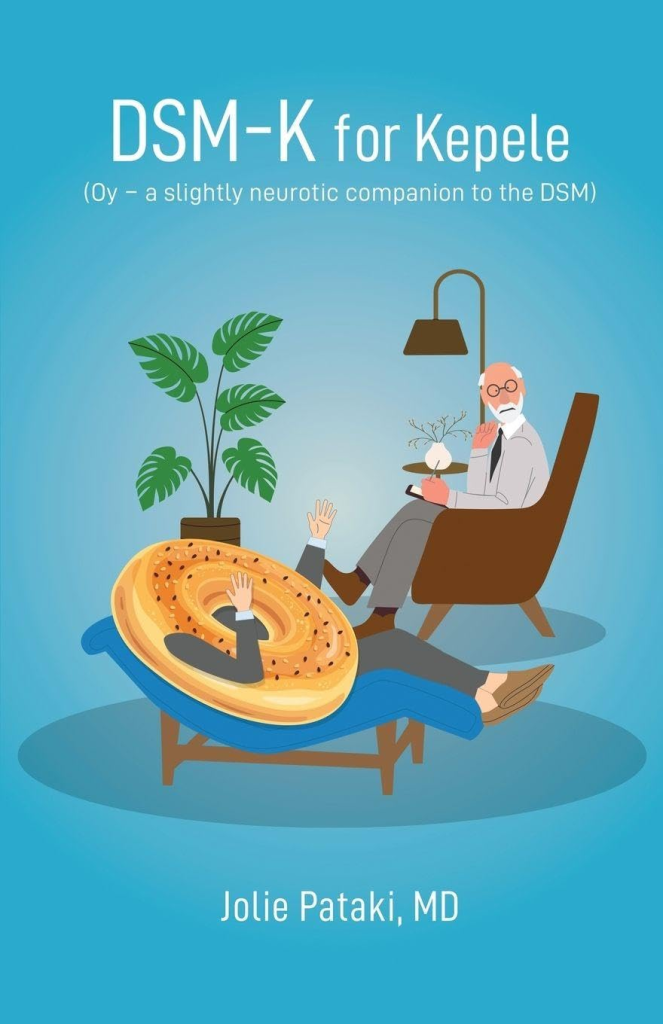
Language does more than communicate. It shapes how we understand ourselves, how we describe emotions, and even how we share struggles with others. English is precise, structured, and full of clinical terminology, but it often falls flat when it comes to describing the human condition in all its messy glory. Yiddish, on the other hand, seems to have a word for every shade of emotion, every awkward family moment, and every little quirk of personality. That is why Dr. Jolie Pataki’s DSM-K for Kepele resonates: it demonstrates that Yiddish effectively captures human mishegos in ways English never could.
Take anxiety, for example. In English, the term “panic attack” is dry and medical. It explains what is happening but leaves out how it feels. In Yiddish, the word is “plotz,” which carries with it the sense of bursting, collapsing, or being completely overwhelmed. The sound of the word alone brings the feeling to life. You can almost picture someone ready to fall over from nerves. That kind of accuracy is what makes Yiddish such a powerful tool for describing human behavior.
Or consider confusion. English might say “disoriented” or “confused,” but Yiddish says “fartummelt.” It does not just tell you that someone is confused; it tells you that they are tangled up, spinning around, unable to make sense of what’s happening. It is confusion with a story built right into the word. You don’t just understand the meaning—you feel it.
This is what DSM-K for Kepele thrives on. Dr. Pataki takes the seriousness of psychiatry and gives it the humor and heart of Yiddish. Diagnoses like “Kvetch Disorder” or “Nudnik Syndrome” are not meant to replace medical understanding, but to shine a light on how culture can make these experiences feel more real. We laugh because we recognize ourselves, our families, and our communities in these playful terms.
What Yiddish does better than English is that it never tries to sound distant or clinical. Instead, it embraces the messiness of life with warmth. A nudnik is not just an “annoying person.” It is that relative who tells the same story at every dinner table, the coworker who won’t stop explaining their vacation, the neighbor who keeps asking for small favors. The word has personality, and so does the diagnosis in DSM-K.
English is efficient, but Yiddish is human. It is emotional, funny, and filled with imagery. It takes psychiatry, which can sometimes feel intimidating or cold, and turns it into something we can all connect to. The brilliance of Dr. Pataki’s work is that she understands both worlds. With decades of experience as a psychiatrist and a deep connection to Jewish culture, she builds a bridge between clinical insight and everyday humor.
And let’s be honest—we all have mishegos. Some of us worry too much, others kvetch too often, and many of us have moments of being completely fartummelt. English might label these things as “anxiety,” “complaining,” or “confusion,” but those words feel thin compared to the full-bodied flavor of Yiddish. By framing them with humor, DSM-K for Kepele makes us laugh, think, and most importantly, feel less alone.
In the end, Yiddish explains our mishegos not because it is smarter than English, but because it speaks to the heart. It understands that life is funny and tragic at the same time, and it gives us words to carry both. That is what makes DSM-K for Kepele a parody of psychiatry and a celebration of how language can make us see ourselves more clearly.
If you’ve ever felt that English doesn’t quite capture your quirks, pick up DSM-K for Kepele. You might just discover that your meshugenah moments have been waiting for their perfect Yiddish name all along.
Head to Amazon to purchase your copy: https://www.amazon.com/dp/1968966498.