Sigmund Freud may be the father of psychoanalysis. But imagine if someone else had written the textbook. It might have sounded a lot more like Dr. Jolie Pataki’s DSM-K for Kepele. Freud gave us theories of the unconscious, repression, and the Oedipus complex. Dr. Pataki, through her alter-ego Dr. Fackacta, gives us Kvetch Disorder, Verklempt Affective Disorder, and a whole catalog of cultural conditions explained in the warm, expressive language of Yiddish. In her hands, psychiatry becomes less about cold definitions and more about lived, human experience.
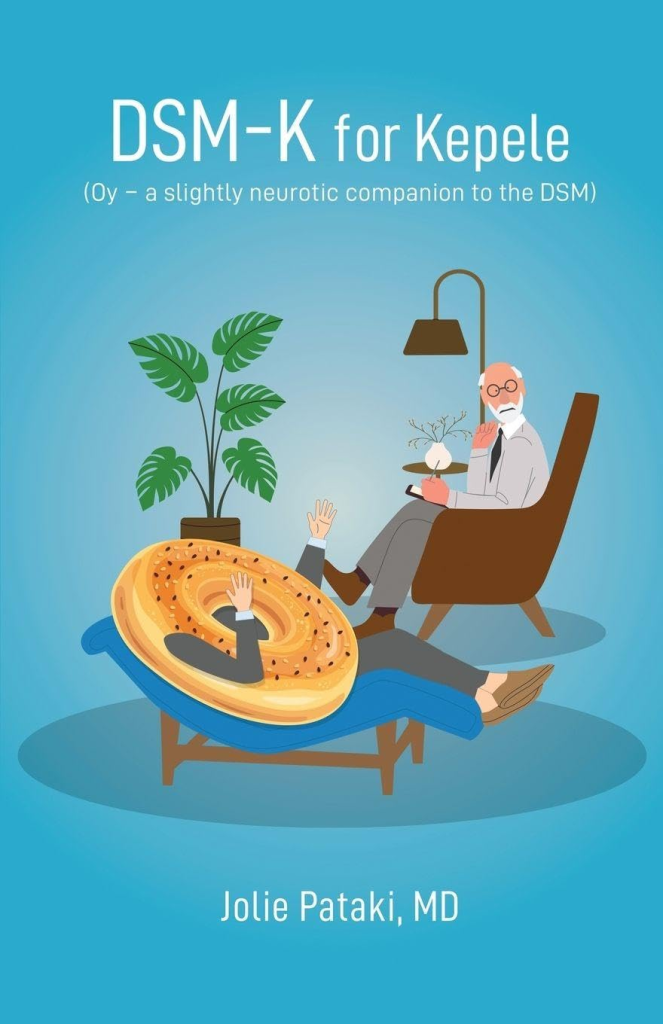
This cultural twist matters because psychiatry has always been shaped by context. Freud himself was Jewish, and it is not hard to imagine how his upbringing influenced his thinking. Yet in the official psychiatric manuals, culture is often tucked into the margins. There is a small glossary of culture-bound syndromes, but the real richness of cultural expression rarely makes it to the page. With DSM-K for Kepele, Dr. Pataki brings culture to the center, showing that language itself can be a powerful diagnostic tool.
Take the word “verklempt.” In English, we might call it being overwhelmed or overly emotional. But “verklempt” goes further. It carries the mix of joy, sadness, pride, and maybe even a tear in the eye that English struggles to capture. That is what makes Yiddish so fitting for psychiatry: it is layered, expressive, and full of humor. It captures not only what a person feels but how they live those feelings in the world.
By introducing disorders like “Fartummelt Disorder” for confusion at family gatherings or “Plotz Attacks” for sudden bursts of anxiety, Dr. Pataki is not just making jokes. She is highlighting how cultural language gives us sharper, more relatable ways to describe our struggles. These playful terms bring psychiatry closer to real life. Patients do not usually walk into an office saying, “I believe I am experiencing generalized anxiety disorder.” They say, “I’m a wreck,” or “I feel like I’m going to plotz.” That is the language of human truth.
Freud once said that jokes reveal hidden truths. DSM-K for Kepele continues that tradition, but with a smile. Where Freud saw dreams and slips of the tongue as windows into the unconscious, Dr. Pataki sees humor as a mirror for our everyday mishegos. It is not about mocking suffering but about making it approachable.
This cultural twist also democratizes psychiatry. Clinical language can be intimidating, especially for those outside the field. Yiddish, on the other hand, is accessible. You do not need to have grown up in a Jewish household to laugh at a kvetching relative or recognize the exhaustion of schlepping through life’s troubles. By rooting psychiatric insight in Yiddish humor, DSM-K for Kepele invites readers of all backgrounds to see themselves in the diagnoses.
There is a larger point here about mental health and culture. Every community has its own way of naming and understanding distress. By honoring those traditions, we make mental health more inclusive. Freud began the work of exploring the human mind, but Dr. Pataki adds a vital dimension: culture and humor as tools of understanding.
In the end, moving from Freud to Farklempt is a way of saying that psychiatry is richer when it embraces the messiness of real life. The Yiddish language, with all its color and warmth, reminds us that even our struggles can be described with a wink.
With DSM-K for Kepele, psychiatry gets a cultural twist that feels long overdue. Freud may have laid the foundation, but sometimes what we really need is a bissel laughter and a whole lot of heart.
Head to Amazon to purchase this amazing book: https://www.amazon.com/dp/1968966498/.