Stigma has long been one of the greatest challenges in mental health. Too often, people hesitate to seek help because they fear being labeled, judged, or misunderstood. Psychiatry has made progress in breaking down these barriers, but stigma still lingers. One unexpected tool in this fight is humor, and in particular, humor through a Jewish lens. Dr. Jolie Pataki’s DSM-K for Kepele uses Yiddish expressions to reframe psychiatric diagnoses, turning shame into laughter and opening the door for more honest conversations.
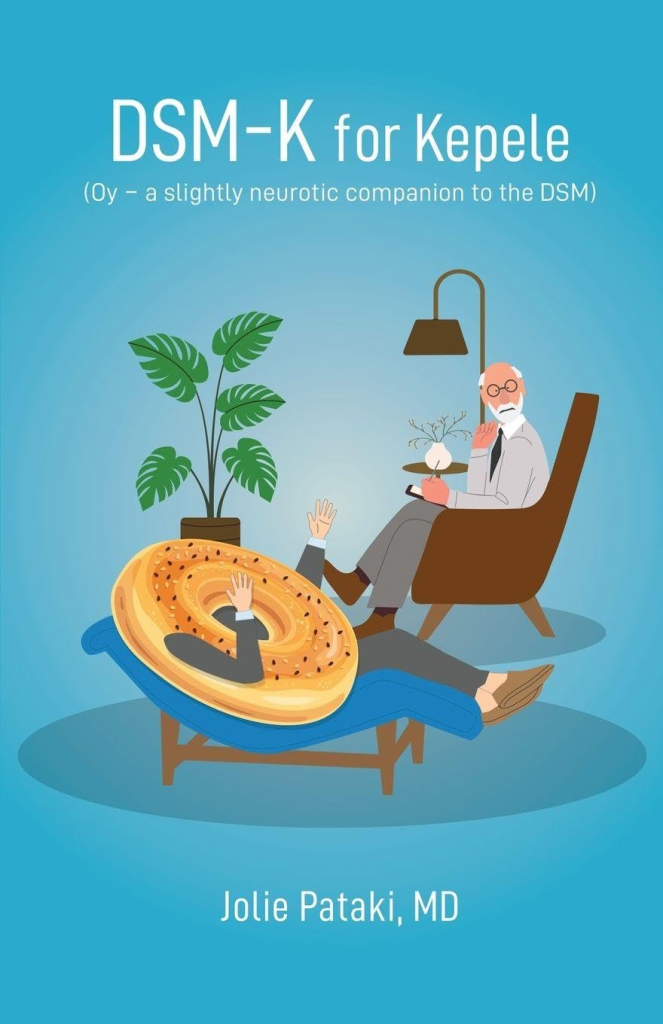
Jewish humor has always found a way to take life’s challenges and make them lighter. From the old shtetls to modern stand-up comedy, humor has been a form of resilience. When faced with hardship, people laughed. Not because the hardship was small, but because laughter gave them strength. The same approach can be applied to psychiatry. When Dr. Pataki introduces us to “Shreklach Disorder” or “Folie-A-Jew,” she is not mocking mental illness. She is showing us that we can talk about it without fear. Humor takes away the sting of stigma.
Stigma grows in silence. When people believe their struggles must be hidden, they feel isolated. Yiddish, with its expressive, often exaggerated way of naming things, brings those struggles into the open. To say you are a kvetch or that you had a plotz attack is easier than saying you have a disorder. It may not be a medical diagnosis, but it is a way of admitting to difficulty. Once the words are spoken, conversation begins. That is the first step to reducing stigma.
There is also compassion built into this lens. Yiddish rarely describes someone in purely negative terms. Even calling someone “meshugenah” carries warmth. It admits a person’s flaws but embraces them too. This is exactly what people with mental health challenges need—to be seen fully, not reduced to their illness. The Jewish lens on psychiatry, as reflected in DSM-K for Kepele, is one that balances honesty with love.
Another way this approach reduces stigma is by making psychiatry approachable for those outside the profession. Many people find psychiatric language intimidating or alienating. But Yiddish humor draws everyone in. A non-professional can laugh at the idea of Post Traumatic Shlepping Disorder or recognize a nudnik in their family. Suddenly, psychiatry is not something distant or clinical—it is part of everyday life. By bringing the language of psychiatry into the warmth of cultural humor, Dr. Pataki breaks down barriers between professionals and the public.
This does not mean minimizing the reality of mental illness. Laughter does not cure depression, anxiety, or psychosis. But it does make space for talking about them. It creates a shared language where shame has less room to grow. For a patient, hearing a psychiatrist use humor can also be a relief. It signals that their struggles are human, not something that sets them apart from everyone else.
Reducing stigma is about more than awareness campaigns. It is about changing the way we speak. A Jewish lens, with its humor, self-awareness, and compassion, gives us tools to do that.
In the end, when we laugh together, we feel less alone. Therefore, through humor and cultural wisdom, we can bring mental health out of the shadows and into everyday conversation. That is how stigma is reduced with a bissel laughter and a lot of heart, which we can inherit and nurture in our lives with DSM-K for Kepele, which proves that psychiatry can honor the seriousness of mental health while still making people laugh. And in that laughter, stigma begins to fade.
Head to Amazon to purchase your copy: https://www.amazon.com/dp/1968966498/.